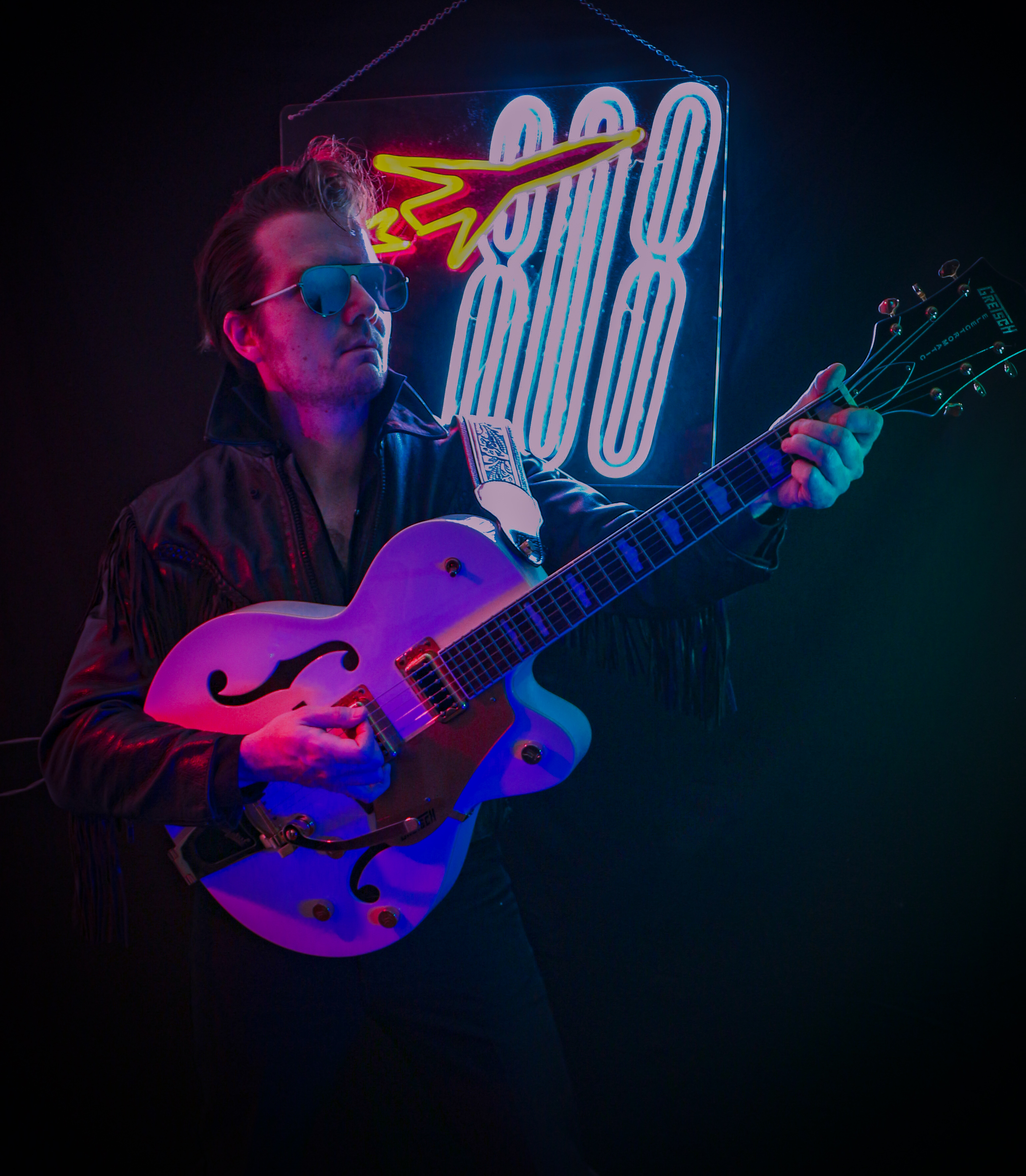
Details of the early
life of John Schooley are sketchy, and historians are still
unsure of many of the details. Various sources place his birth
either in Columbus, Ohio or Vancouver, British Columbia. We
do know that his family moved to the rural enclave of Niangua,
Missouri when he was still quite young. His parents were sharecroppers,
barely scratching out a living from the rocky soil of the
Ozark Mountains.
The youngest
of eight or possibly nine siblings, John Schooley did not
take to farming, or, apparently, work of any kind. He could
be found, often as not, shirking his chores to hunch over
his guitar. He did not have a “One Man Band”
setup as yet, locals report only that he would stomp his
foot on a board or on the front porch, frequently scaring
the cows. Though it was not a musical family, the youngest
of the Schooley clan was “plum gone over that guitar,”
according to one family member interviewed years later.
Since it was nearly 50 miles to the nearest
proper record store, young Schooley had a hard time coming
by the country, blues, ragtime, and punk music he was so
enamored with. The family Victrola was stocked with any
78’s that could be found, mostly by Jimmie Rodgers,
Blind Lemon Jefferson, Doctor Ross, and Don Van Vliet. Most
evenings the family tuned to radio station KWTO out of Springfield,
to hear the “Carter Sisters and Mother Maybelle with
Chet Atkins and his Famous Guitar” perform as part
of the syndicated “RadiOzark” network. Although
the “Carter Scratch” of Mother Maybelle Carter
seems to have been an early influence on Schooley’s
playing, the more genteel jazz-influenced picking of Atkins
most certainly was not.
School was never to his liking and Schooley
quit after graduating the fifth grade. Chafing at the dreary
small town life of Niangua, Schooley left never to return.
He rambled north to Columbia, Missouri, where the local
musical combo “The Untamed Youth” had been making
a name for themselves. Untamed Youth had recorded for Norton
Records out of New York City to some acclaim, but by the
time Schooley arrived the band was no longer active. Founder
Deke Dickerson had moved to California, and there were really
no other bands in town.
Into this musical vacuum Schooley entered,
first trying to put together a hot-jazz combo along the
lines of the then-popular Django Reinhart. Schooley was
unable to find suitable musicians, and also couldn’t
really play very well, so that idea was soon abandoned.
Then, billing himself as “John Schooley and His One
Man Band”, he rigged up a kick drum and hi-hat and
began performing at “house frolics” and on the
sidewalk in front of local record store Whizz Records. He
met with minimal success. The repetitive pound of the kick
drum combined with Schooley’s rather gruff vocals
seemed only to drive business away from the already failing
retailer. He was frequently chased away by the proprietor
with a broom shortly after setting up. He fared little better
at the “house frolics.” Being unwilling (or
perhaps unable) to learn pop hits of the day, Schooley tried
to force his listeners to dance to his own frequently atonal
blend of blues and country, again with minimal success.
The musical scene in Columbia was so stagnant
that when it was announced that bluegrass stars The Oblivians
were coming to town, Schooley was able to secure the opening
slot even though he had no band together at the time. A
suitable bass player was never found, and with the Oblivians
show rapidly approaching Schooley set out to work up a set
with scarcely a week remaining before the show. The guitar,
drum, and vocal trio dubbed themselves “The Revelators”
and much to the surprise of everyone they didn’t suck
too bad.
Eric Oblivian was so impressed with this
lack of suck that he offered to record the band on his “Goner”
record label, a new Memphis enterprise he had begun in partnership
with talent scout Ralph Peer. The Revelators had already
sent a demo to Crypt Records, however; and Crypt president
Tim Warren was very excited about the band.
Schooley continued performing as a one
man band on occasion, and even worked up some home recordings.
Using the (even then) antiquated technology of the “boom
box” in conjunction with one Radio Shack microphone,
he recorded two songs in the basement of the Alpha Gamma
Sigma agricultural fraternity. One was a Billy Childish
number, “Pretty Baby”, and the other a re-working
of the traditional folk holler “Rock and Roll Hootchie
Koo”. When he sent the tape to Eric Oblivian he was
very excited. Oblivian rushed the single (released on the
new “45 RPM” format) into production. It failed
to chart.
Meanwhile, Crypt had released a single
by the Revelators and now wanted an LP. When the record,
titled “We Told You Not To Cross Us” was released
it caused a sensation in at least three Missouri counties
and parts of Arkansas and Illinois. The Revelators were
immediately rushed off to a whirlwind tour of Europe, which
included performances for the as-yet not-dead Princess Diana
and Archduke Ferdinand. Following a grueling North American
tour, the group recorded one more LP (still unreleased)
and promptly broke up.
Tiring of Missouri, Schooley lit a shuck
for Texas and took whatever work he could find, from oil
roughneck to hotel elevator operator. He eventually started
another musical combo, the Hard Feelings, not unlike the
Revelators in musical style and spirit. Collectors have
turned up at least two LP’s and a number of 45’s
by the Hard Feelings, and it is known they made infrequent
tours of Europe and North America.
The recordings of John Schooley and His
One Man Band, however, are not as well documented. Only
one other single, on “Ball Records” from Maine,
has turned up. Eventually, Schooley added harmonica, snare
drum, and washboard to his kick and hi-hat apparatus, enabling
him to make an increasingly louder racket. Voodoo Rhythm
recently uncovered the tapes of these songs, long presumed
lost, in an oil drum outside of Lockhart, Texas. They seem
to represent a shift by Schooley away from the rougher sound
that characterized the Goner and Ball recordings to a more
full, rhythmically complex sound. While the story of John
Schooley and His One Man Band remains shrouded in half-truths
and outright falsehood, these recordings should help give
musical historians and folklorists a more accurate portrait
of the man and his music. |